The Answer Box: The New Homepage Isn’t A Homepage At All, It’s A Question.
Team
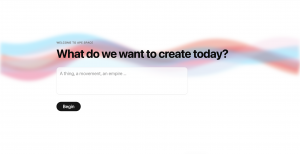
If you’ve looked at space.apesonfire.com lately, you’ve already seen the future hiding in plain sight.
It’s not a magic feed. No special nav tree. It’s not a dashboard with seventeen widgets screaming for your attention.
It’s a simple input field that asks: What do we want to create today?
The Answer Box – A UI Choice, And The Core Of A Distribution Thesis
Google did it. Perplexity did it. ChatGPT did it. And even Yahoo (yes, still alive) can’t help itself. Every product that wants to own “where decisions happen” is doing it. The internet’s UI is collapsing into a single shape: the answer box.
The old homepage was a place you visited. The new homepage is where you ask. And where you expect an answer. If you’re building a brand, a product, or a point of view: you need to adapt your content strategy to the new interface.
Three things are happening at the same time:
- Search is being re-bundled into answers. People don’t want links. They want the synthesis.
- Distribution surfaces are compressing. The UI has less room for the brand, the machine. Fewer clicks. Less patience. Less context.
- Attribution is becoming optional. Not because anyone is evil (though: lol), but because the interface is not showing its work the way we were used to (sources don’t matter that much anymore on the surface, if knowledge and thinking are abundant)
So the old strategy — “share content, rank on Google, collect clicks” — is no longer the default path to awareness. We need to optimize for a new era, measuring attention in ‘Share of Response’ not ‘Share of Voice’.
The new game is: get your ideas into the response of the ‘model’ – and that includes human minds.
What Wins In The Answer Box Era
Here are five formats that survive (and compound) when the UI collapses:
1) Sharp claims (that can be repeated)
Not hot takes or vibes. Actual claims, defensible cognitive moats.
A claim is a sentence somebody can carry into a meeting without you.
Example: “Attention is a supply chain.”
You see? We said it. If it’s not repeatable, it’s not distributable.
2) Frameworks (that reduce uncertainty)
Frameworks travel because they help people decide.
A good framework makes someone feel smarter in under 30 seconds. Like you, while you are reading this.
3) Original data (even small)
You don’t need a lab. You need something you saw that others didn’t document.
A screenshot. A pattern across 20 customers. A before/after. A list of failure modes.
Originality is the new SEO.
4) Memetic phrasing (earned, not manufactured)
Yes, words matter.
Not because of “branding.”, but because the answer box is basically a metaphor for a compression algorithm – meaning, association, affiliation, compressed into verbiage that can be owned. Articulation that becomes habitual.
If your phrasing is sticky, it gets carried forward.
5) Narrative threads (the human layer)
The answer box is efficient. Humans aren’t. Narrative is how people decide what to believe, who to trust, and what to try next.
So you still need story — but story as a delivery vehicle for a claim or framework, not story as decoration.
What To Measure If Clicks Don’t Count
If you keep measuring “traffic” as the KPI, you’ll optimize for a world that’s leaving.
In the answer-box era, you care about:
- Mentions: are people repeating the phrasing?
- Citations: are answer engines / newsletters / other writers referencing you?
- Prompt inclusion: are people asking the system for you? (“What would Apes on Fire say about…?”)
- Downstream behavior: do the right people DM you, book time, try the product, steal the framework? (Good.)
You can’t win “content”, if content is always just a prompt away. Which is why our front page is a question. And the machine that you rely on for the answer. The answer box. Everything else is implementation detail (beautiful, intricate implementation detail… but still).
TL;DR
The internet is becoming an answer box.
So your content needs to become:
- claims people can repeat
- frameworks people can use
- reference people can return to
- narratives people can feel