The Craft Of Thinking
Team
If you looked at the AI market right now, you could be forgiven for thinking there is only one serious thing an agent should do:
Write code. End of story.
Every week, a new coding agent appears. It refactors code, writes code, tests code, opens pull requests, spins up apps, and promises to make software production faster, cheaper, and a little more sleep-deprived. That is real progress. It is also, increasingly, a category error.
The industry is mistaking the most visible agent capability for the most important one. Coding is unusually seductive because it is legible, testable. You can benchmark it. Demo it. Screenshot it. Watch it produce a working artifact. Software velocity is easy to see, easy to measure, and easy to sell.
But code is not the end all be all of human expression.
And it is certainly not the end all be all of craft.
Craft begins earlier.
With thought.
Before there is software, there is an idea. Before there is implementation, there is framing. Before there is a system, there is a decision about what should exist, why it matters, what tradeoffs are acceptable, and what game is actually being played. Specification.
Craft follows thought.
Code does too.
That is the hypothesis behind APEx.
The Real Bottleneck Has Never Been Implementation
A lot of today’s AI discourse quietly assumes that if an agent can code, it can solve almost anything. That sounds clever until you ask a more annoying question:
How many important problems are actually code problems at the start?
Most are not.
Most are ambiguity problems.
- What are we actually trying to do?
- What problem matters most?
- What changed?
- What is stuck?
- What option has leverage?
- What is the right intervention here?
That is not coding work. That is cognitive work.
It’s the work upstream of software: strategy, framing, synthesis, prioritization, narrative, concept development, decision-making, creative direction. The work that produces a strategic brief, a product thesis, a recommendation, a roadmap, a pitch, a story architecture, a workshop scaffold, a sharper point of view.
And upstream work matters disproportionately, because the quality of implementation rarely exceeds the quality of the thinking that shaped it.
You can build the wrong thing beautifully.
Human beings do this all the time.
Code Is Powerful. It Is Also (Still) Expensive.
This is the other thing the market likes to forget.
Software is not just magic. It is commitment.
Every custom app brings a small parade of consequences behind it: auth, permissions, infrastructure, security, maintenance, observability, versioning, support, edge cases, updates, and the recurring joy of discovering that your elegant little solution now needs documentation, ownership, and a backup plan.
Sometimes that cost is absolutely worth paying. Sometimes software is the cleanest answer. If a workflow repeats often enough, touches enough users, or needs durable automation and reliability, then yes: absolutely build that thing!
But many problems do not need an app.
They need a better brief.
A clearer decision.
A stronger concept.
A sharper recommendation.
A more useful structure.
A more truthful frame.
Meet APEx
That is why we built APEx.
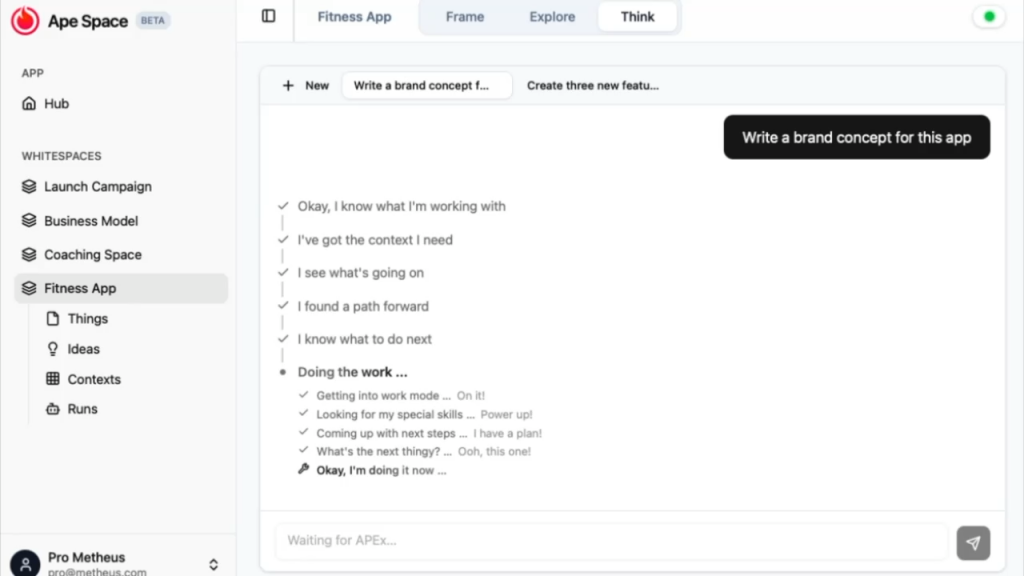
APEx is our new cognitive partner inside Ape Space, designed not to collapse every messy problem into an implementation task, but to help people work through the long middle of actual thinking: strategy, transformation, product development, creative writing, synthesis, reframing, direction-setting, and decision support. It is explicitly meant to drive the intelligence of the whitespace, not just answer prompts on command.
It does not begin with, “What app should I build?”
It begins with, “What is actually going on here?”
Like in real life, that is often the more valuable question.
Because intelligence is not just the ability to produce an artifact. It is the ability to improve the quality of the intervention.
Sometimes that intervention is code.
More often it’s not.
OODA, Ralph, And The Refusal To Rush Ambiguity
Military strategist John Boyd developed one of the most powerful decision frameworks ever invented:
OODA – Observe » Orient » Decide » Act
The idea is simple: Winning in complex environments isn’t about perfect planning. It’s about fast, adaptive loops of understanding and action.
- Observe the environment.
- Orient yourself within it.
- Decide the next move.
- Act.
Then repeat.
Again. And again. And Again
The side that loops faster wins. This framework became the backbone of modern maneuver warfare. And now, one of the inspirations behind APEx.
The second inspiration is Ralph Wiggum.
Yes. That Ralph. The kid from The Simpsons who famously declares things like: “I’m in danger.”

Ralph has a very special way of thinking.
He tries things. They fail. He tries again. Things get weird. He tries again. And somehow — occasionally, mysteriously — something brilliant emerges from the chaos. This might not sound like a disciplined thinking method. But anyone who has ever worked on creative or strategic problems knows the truth:
Breakthrough thinking often looks like productive confusion.
Ideas collide.
Frames shift.
Assumptions collapse.
New patterns appear.
Ralph, unintentionally, captures something important about creativity:
You have to wiggum your way through uncertainty.
Under the hood, APEx is built on our own blend of OODA plus Ralph Wiggum: a loop that knows how to observe, orient, decide, and act, while also staying in motion long enough to handle uncertainty without panicking and turning every open question into premature certainty. As we put it in our latest release, APEx is optimized for “the kind of work most AI systems are still oddly bad at once things get messy.”
That distinction matters.
Coding work usually benefits from clear constraints. Something runs or it does not. A test passes or it fails. Thinking work is different.
There is no compiler for strategy.
No linter for judgment.
No unit test for creative direction.
No passing build for whether a recommendation is politically intelligent, narratively coherent, and timed well enough to matter.
So the job is not deterministic execution alone. The job is structured exploration.
Observe.
Orient.
Decide.
Act.
Then loop again.
Not because ambiguity is a bug, but because ambiguity is often the raw material for bold ideas.
Why This Matters
This is not an anti-code argument.
It is a hierarchy argument.
Orient.
Decide.
Create the right artifact.
Then implement in code if warranted.
That sequence matters because code is one execution mode, not the definition of intelligence. The AI market is currently obsessed with agents that can produce implementations. We are more interested in agents that improve the quality of interventions. That is a different promise. We believe, AI should help people hold complexity, move through ambiguity, and build better things with more coherence and momentum.
That is the lane APEx is built for.
Not to worship implementation, but to improve how we think.
At the layer where craft actually begins.
With thought.